
What You’ll Learn
- Why digital products generate higher conversion rates than courses
- The hidden production and maintenance costs of online courses
- How to identify which product format works best for your audience
- A proven 7-day launch framework for your first digital product
- Real-world examples of creators earning $10K+ monthly with products
1. The Friction Factor: Why Most Courses Fail
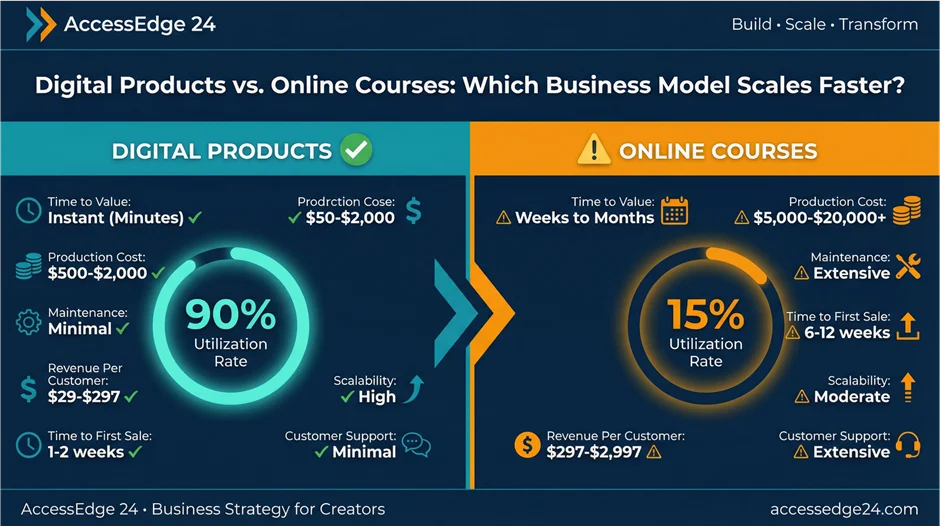
In the battle for creator revenue, online courses have long been positioned as the gold standard. For the past decade, the narrative has been consistent: ‘Create a course, and you’ll build passive income.’ Yet the reality tells a different story. According to industry data, the average online course has a completion rate of just 15 percent. This means that 85 percent of students who invest their money never finish what they paid for.
The culprit is friction. Online courses require an enormous commitment of time and mental energy from the buyer. A typical course spans 20 to 40 hours of video content, spread across 8 to 12 weeks. Students must carve out dedicated time, maintain motivation, and push through the inevitable plateau where enthusiasm meets reality. Most never make it past week two.
Digital products, by contrast, provide instant gratification. A template, checklist, or specialized tool solves a specific problem now, without requiring the user to watch 40 videos or complete weekly assignments. The value is immediate and tangible.
“85% of students never finish the online courses they purchase. Digital products have a 90% utilization rate because they solve problems immediately.”
2. The Economics of Creation: Hidden Costs Nobody Talks About
Creating an online course is expensive—far more expensive than most creators realize. Here’s what the typical course creator doesn’t account for:
Video Production: Professional video requires equipment, editing software, and time. A single hour of edited video typically takes 8 to 12 hours of production work. For a 20-hour course, that’s 160 to 240 hours of production labor.
Hosting and Platform Fees: Courses live on platforms like Teachable, Kajabi, or Thinkific. These platforms charge 5 to 10 percent of revenue in transaction fees, plus monthly hosting fees ranging from $99 to $499.
Ongoing Maintenance: Technology changes. Video players update. Payment processors evolve. A course requires constant maintenance to stay functional. When a student reports a broken video link or outdated information, the creator must re-record and re-edit.
Customer Support: Courses generate support tickets. Students get stuck, ask questions, or need clarification. This support burden scales with course enrollment and consumes 5 to 10 hours per week for a moderately successful course.
Digital products sidestep most of these costs. A template is created once and updated occasionally. A checklist is a PDF that never needs hosting. A tool or spreadsheet requires minimal maintenance. The production cost is lower, and the ongoing burden is negligible.
Products vs. Courses: Head-to-Head Comparison
3. The Conversion Math: Why Products Win
Let’s talk numbers. A digital product priced at $47 needs 213 sales to generate $10,000 in revenue. An online course priced at $497 needs only 20 sales. On the surface, the course looks more efficient. But here’s where the math breaks down.
Selling 20 courses requires significant marketing investment and audience trust. Most creators spend $3,000 to $5,000 in ads or content creation to generate 20 course sales. That’s $150 to $250 in customer acquisition cost per sale. After platform fees and refunds, the net revenue per course is closer to $350 to $400.
Selling 213 digital products, by contrast, is achievable through organic reach and word-of-mouth. A $47 product has a lower barrier to purchase. Customers are more willing to take a chance on a low-cost item. Refund rates are lower because the product delivers immediate value. The customer acquisition cost drops to $10 to $20 per sale, and the net revenue per product is closer to $35 to $40.
Over a year, the creator selling 213 products generates $10,000 with lower marketing spend, less support burden, and higher customer satisfaction. The creator selling 20 courses generates $10,000 with higher marketing spend, extensive support obligations, and lower customer satisfaction (because 85 percent never finish).
“Digital products scale through volume and word-of-mouth. Courses scale through marketing spend and support burden. Products win on efficiency.”
4. The “Finish” Factor: Why People Actually Use Products
Here’s a psychological insight that most course creators miss: people rarely finish what they start. This isn’t laziness—it’s a mismatch between expectation and reality. A student enrolls in a course expecting to transform their life in 12 weeks. When they realize it requires consistent effort and discipline, they lose motivation.
Digital products don’t have this problem. A template is used immediately. A checklist is completed in an afternoon. A tool delivers results in minutes. There’s no expectation of a long-term commitment, so there’s no disappointment when the commitment doesn’t materialize.
This difference has profound implications for your business. A customer who uses your product is satisfied. A satisfied customer leaves a positive review, recommends you to a friend, and buys your next product. A customer who abandons your course is frustrated. A frustrated customer leaves a negative review, warns others away, and never buys from you again.
The ‘finish factor’ means that digital products generate more word-of-mouth marketing, higher repeat purchase rates, and stronger brand reputation than courses.
5. Real-World Examples: Creators Winning with Products
The shift toward digital products is already happening. Successful creators across industries are abandoning courses in favor of products.
Example 1: The Productivity Creator: Sarah, a productivity coach, launched a $37 Daily Planner Template as an experiment. She expected 50 sales in the first month. Instead, she got 340 sales and $12,580 in revenue. She then bundled the template with three complementary checklists into a $97 Productivity Toolkit and sold 180 units in month two. Total revenue: $17,460 in two months. Her course, by comparison, had generated $8,000 in its first three months with 10 sales and extensive support obligations.
Example 2: The Designer’s Toolkit: Marcus, a graphic designer, created a Figma template library priced at $49. He marketed it to his email list of 5,000 and generated 320 sales in the first week ($15,680). He then created a second template library for a different niche and repeated the process. Within six months, he had four product lines generating $80,000 in annual revenue—all with minimal support burden.
Example 3: The Automation Specialist: Priya built a Google Sheets calculator for freelancers to track profitability. She priced it at $29 and sold 1,200 copies in the first year ($34,800). She then created five more calculators for different professions. Her product line now generates $150,000+ annually with zero customer support required (because the product is self-explanatory).
Ready to Launch Your First Digital Product?
Join 5,000+ creators who’ve scaled their income with digital products.
Get our free toolkit with templates, pricing strategies, and a 7-day launch checklist.
Download the Creator Toolkit → accessedge24.com
6. When Courses Still Make Sense
This article isn’t an argument against online courses. Courses have their place. If your goal is to provide deep, transformational education—to teach someone a complex skill that requires weeks of practice and feedback—a course is appropriate. Courses work well for certification programs, professional development, and highly specialized training.
However, for most creators looking to build sustainable income, digital products are the better starting point. They’re faster to create, easier to market, and more profitable to scale. A smart creator strategy often combines both: launch a digital product to build an audience and generate quick revenue, then create a premium course for a subset of that audience who want deeper transformation.
7. The Verdict: Why Smart Creators Choose Products
The evidence is clear. Digital products outperform courses on nearly every metric: faster time to market, lower production costs, higher completion rates, better customer satisfaction, and superior scalability. While courses still have a role in the creator economy, they’re no longer the default choice for building sustainable income.
If you’re a creator looking to monetize your expertise, start with a digital product. Identify a specific problem your audience faces, create a tool or template that solves it, and launch within 7 days. Test the market, gather feedback, and iterate. Once you’ve proven demand and built an audience, you can explore premium offerings like courses or coaching.
The future of the creator economy belongs to those who can deliver value quickly, scale efficiently, and build genuine customer relationships. Digital products are the engine of that future.
About the Author
AccessEdge 24 Editorial Team
AccessEdge 24 is a digital platform dedicated to helping solopreneurs, content creators, and small business owners build sustainable income through smart digital products and automation. Our team of strategists, designers, and product experts share practical insights and proven frameworks.